Continuous Glucose Monitoring (CGM / FGM)
A small sensor on your upper arm shows around the clock how your blood sugar behaves — with meals, exercise and sleep. No daily finger pricks, and a complete picture for your therapy.
Continuous glucose monitoring with CGM (Continuous Glucose Monitoring) or FGM (Flash Glucose Monitoring) enables precise tracking of glucose patterns over 24 hours without repeated finger pricks. In our practice, we use the current systems Dexcom G7 and FreeStyle Libre 3 (Abbott). The sensors show not only the current blood sugar value but also trends — rising, falling, or stable — and help patients understand their condition better and manage it independently.
Our Sensor Systems
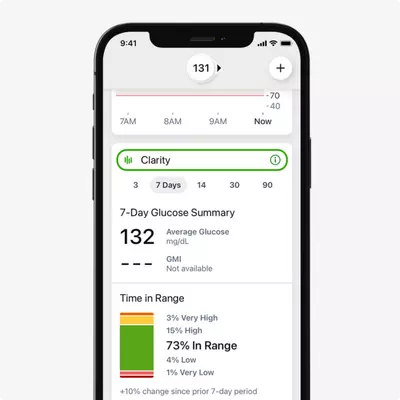
Dexcom G7
Real-time CGM with Clarity app: glucose summary, time in range, and customizable alerts for hypo- and hyperglycemia. Automatic data transmission to smartphone and smartwatch.
Image: © Dexcom, Inc. · dexcom.com →

FreeStyle Libre 3 (Abbott)
Flash glucose monitoring with LibreView platform: Ambulatory Glucose Profile (AGP), time in range, and daily glucose patterns. Automatic transmission to smartphone. 14-day wear duration.
Image: © Abbott Diabetes Care · freestyle.abbott →
Diagnostic Value
- Nocturnal hypoglycemia: Many patients experience nighttime low blood sugar without noticing. CGM/FGM reveals this.
- Time in Range (TiR): The percentage of time glucose stays in the optimal range is a better quality metric than HbA1c alone.
- Data-driven therapy adjustment: Based on sensor data, insulin doses and meals can be targeted.
- Foster self-competence: Patients immediately see how food, exercise, and stress affect their blood sugar.
Use in Our Practice
CGM systems have two distinct uses in our practice. Which applies to you depends on your diagnosis and therapy type.
CGM for Diabetes — Insurance-Covered Benefit
For patients with type 1 or type 2 diabetes mellitus under intensive insulin therapy (ICT) or insulin pump therapy, continuous glucose monitoring is a covered benefit. Statutory health insurance covers sensor costs when prescription criteria are met.
Indications for coverage:
- Insulin therapy with at least 3 daily injections (ICT) or insulin pump (CSII)
- Recurrent severe hypoglycemia or impaired hypoglycemia awareness
- Unsatisfactory metabolic control despite optimized insulin therapy
- Pregnancy with pre-existing diabetes
In our practice, we support you with initial prescription, sensor placement, and regular review of CGM data. Therapy adjustment is based on Clarity or LibreView reports — with attention to time in range, glycemic variability, and hypoglycemia rate.
CGM as Metabolic Screening — Self-Pay Service
Self-PayEven without a diabetes diagnosis or insulin therapy, time-limited glucose monitoring provides valuable insights into your metabolism. In this case, it is an individual health service (self-pay), with costs covered by you.
Who benefits from this?
- Overweight and obesity: The biofeedback effect can support weight loss — you recognize which meals trigger problematic glucose spikes and adjust your behavior independently.
- Insulin resistance: Even with normal HbA1c, CGM already shows postprandial glucose spikes and increased glycemic variability — early signs often missed in fasting labs.
- Prediabetes (IFG / IGT): With borderline values, CGM provides a realistic 24-hour picture and motivates targeted lifestyle changes that can prevent progression to diabetes.
- Metabolic syndrome: Combined with BIA measurement and lab screening for comprehensive metabolic analysis.
Our self-pay package includes:
- Sensor placement in the office — professional placement of a Dexcom G7 or FreeStyle Libre 3 and training on the smartphone app
- 4 weeks of continuous monitoring — automatic glucose capture around the clock, including trend arrows and alerts
- Physician review and consultation — analysis of Ambulatory Glucose Profile (AGP), time in range, and glycemic variability with specific recommendations for nutrition, movement, and meal timing
Other applications: athletes for performance optimization, patients with family history of diabetes, pregnancy planning with risk factors.
The Biofeedback Effect: See What Food Does
The greatest advantage of continuous glucose monitoring lies not just in the data, but in real-time feedback. When you see on the sensor how your blood sugar responds after a meal, it changes your behavior — more sustainably than any nutrition rule on paper.
Research confirms this effect: In a landmark study from George Mason University (2024), prediabetes patients using CGM-guided nutrition counseling achieved double the weight and fat loss compared to controls — without specific diet instructions.[1] A large cohort study with over 2,200 participants also showed: Just 28 days of CGM use led to measurable improvements in hyperglycemia, glycemic variability, and body weight — especially in overweight people without diabetes.[2]
The principle is simple: What you measure, you can change. A glucose sensor makes the connection between nutrition, exercise, and metabolism visible — and that motivates lasting change.
Note: There is no commercial affiliation with the manufacturers mentioned. Sensor selection is based solely on medical suitability, availability, reimbursement status and your preferences.
References
- Basiri R, Cheskin LJ. Personalized Nutrition Therapy without Weight Loss Counseling Produces Weight Loss in Individuals with Prediabetes Who Are Overweight/Obese: A Randomized Controlled Trial. Nutrients. 2024;16(14):2218.
- Ehrhardt N, Al Zaghal E. Behavior Modification in Prediabetes and Diabetes: Potential Use of Real-Time Continuous Glucose Monitoring. J Diabetes Sci Technol. 2019;13(2):271–275.
Address
Georg-Schumann-Straße 257 · 2nd floor
04159 Leipzig
Contact
Phone: 0341 5210871
Email: info@internist-wenzel.de